
Behind the Scenes

Architecting the Perfect Click

A deep dive into the engineering, mechanics, and design philosophies powering our upcoming casual clicker game. From initial concept to polished UI, explore how we build a scalable and satisfying experience.

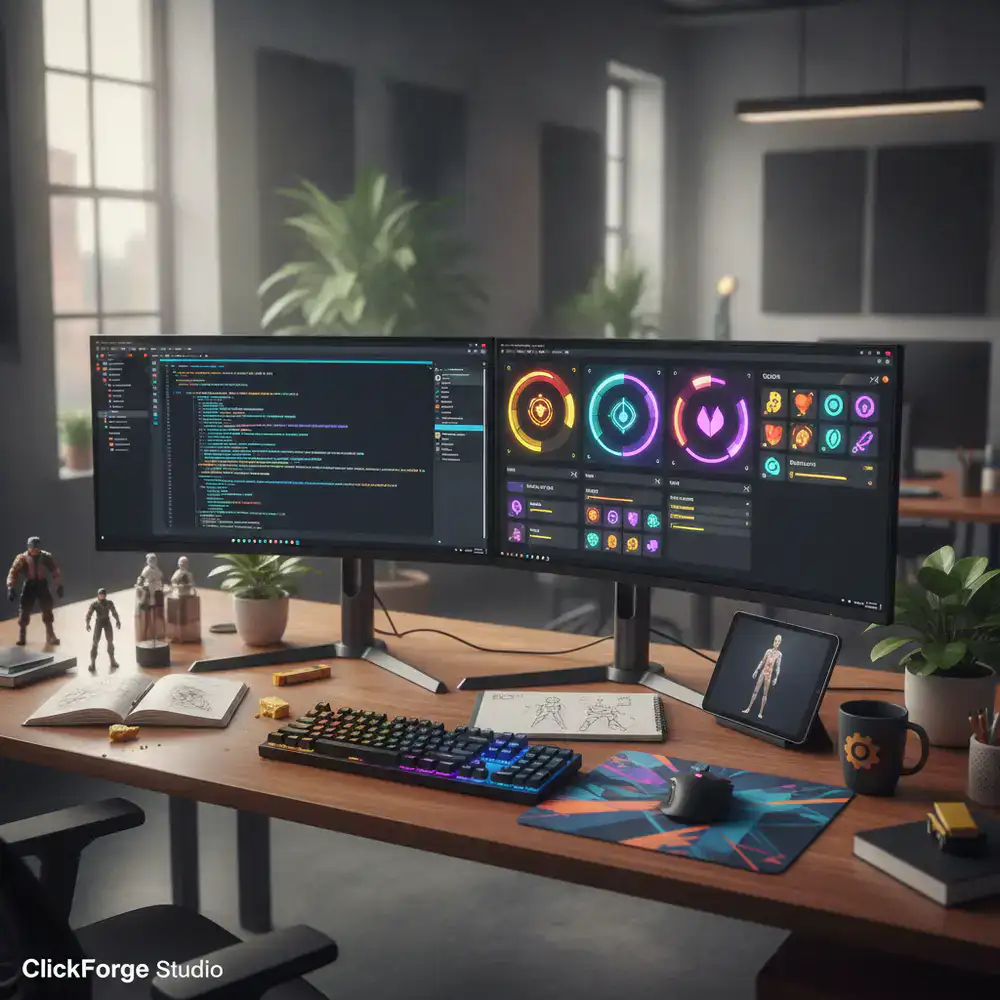
ClickForge Studio developer workspace with code and game UI prototypes
Phase 01

The Core Concept

Every great idle game starts with a satisfying loop. At ClickForge Studio, our development journey began with a simple question: How do we make the very first interaction inherently rewarding? The concept evolved from a basic incremental counter into a multi-layered progression engine.

We drafted dozens of prototypes focusing purely on pacing. A casual clicker game lives or dies by its early-game momentum and its late-game depth. By establishing a strong narrative wrapper around our abstract numeric progression, we ensure players remain engaged whether they play actively or let the game idle for days.

Game UI wireframes showing progress bars and upgrade cards
Visual Feedback

Designing the Interface

A clutter-free UI is crucial when numbers start scaling into the trillions. We utilize squircle radii, bold sans-serif typography, and distinct color-coding for different upgrade paths. Every tap is accompanied by micro-animations and particle effects to ensure the player feels the impact of their actions instantly.

  • Responsive scaling for all devices
  • Clear hierarchical data display
Code snippet showing exponential cost scaling functions
Core Engineering

Robust Game Logic

Handling massive numbers efficiently requires optimized data structures. We implemented custom BigInt wrappers to prevent precision loss as upgrade costs skyrocket. Additionally, our offline progression system simulates background ticks accurately, ensuring fair rewards when players return.

Offline Calculation Accuracy

By calculating delta time and applying current production rates through an integral formula, we guarantee identical progression speeds whether the app is active or suspended.

Mathematical Design

Upgrade Balance Mechanics

Tier 1: Linear Base

Early Game

The foundation of the player's economy. Base clicks and automated generators scale linearly in cost but provide flat production bonuses. This tier establishes trust and teaches the fundamental interaction loop without overwhelming the player.

Tier 2: Exponential Multipliers

Mid Game

As base production stales, players unlock percentage-based modifiers. To maintain challenge, the costs for these upgrades use an exponential growth curve formula Cost = Base * (GrowthFactor^Level), requiring players to strategize their spending.

Tier 3: Synergy Caps

Late Game

High-end gameplay introduces logarithmic scaling limiters to prevent integer overflow while offering prestige-layer tokens. Synergy combinations force dynamic build changes rather than purely waiting for a single bar to fill.

Project Timeline

Development Roadmap

Q1: Engine Foundation

Establishment of the ClickForge Studio core architecture. Implementation of basic math libraries, offline progress simulation, and wireframing the user interface.

Completed

Q2: Core Loop & Visual Polish

Integrating particle systems, animated transitions, and finalizing the Tier 1 and Tier 2 upgrade balance. Initial internal playtests conducted.

In Progress

Q3: Closed Beta & Synergy Mechanics

Opening the game to select community testers to stress-test late-game exponential formulas and gather telemetry on user retention.

Q4: Soft Launch & Live Ops

Regional soft launch to test server architecture for cloud saves, followed by global rollout and scheduled content updates.

Help Us Shape the Game

Are you passionate about game design, math, and balancing? Join our developer mailing list to receive technical deep-dives and early access to build versions before they hit the public testing phases.